

































 +44 207 043 6026
  +357 252 30233
  +971 454 01311
  +902 129 008 710
  +302 112 340 656
  +1 (888) 2033901


Greece Real Estate Market Report H1 2026: Prices, Trends, and Golden Visa Impact
-
 10-minute read
 -
50 views
-
Share
 10-minute read
 50 views
 Share
Share
Nasos Fousias
Head of Property Department in Greece
- Last edited: October 7, 2026
Greece’s investment property market remained resilient in H1 2026, with apartment prices rising by 5.7% YoY in Q1 and 5.5% in Q2, while newer stock continued to outperform older housing. Foreign demand is concentrated in Athens, Piraeus, Thessaloniki and prime coastal markets, with Chinese investors accounting for more than half of active Golden Visa investor permits and growing participation from US, UK, Israeli and Turkish buyers. More than 75% of new Golden Visa applications are linked to €250,000 commercial-to-residential conversions, typically compact 40–65 sq. m units, while premium buyers in Attica increasingly face real entry budgets of €1 million or more, especially on the Athens Riviera.
This article breaks down who is buying Greek property, which types of assets attract the most demand, where investors are concentrating, how prices differ by submarket, and how the Golden Visa framework is reshaping investment activity across Greece.
Apartment prices in Greece increased by 5.7% year on year in Q1 2026 and by 5.5% in Q2. Growth therefore remains positive, although the pace has moderated from 9.1% in 2024 and 8.3% in 2025.
Newer housing continues to outperform older stock. Apartments up to five years old increased in value by 6.0% in Q1 and 6.2% in Q2, while older apartments recorded growth of 5.5% and 5.0% respectively. This gap is important because the Greek housing stock is dominated by older buildings, particularly apartments constructed in the 1960s–1980s, while much of the international investment market is concentrated in newly built, fully renovated or repositioned property.
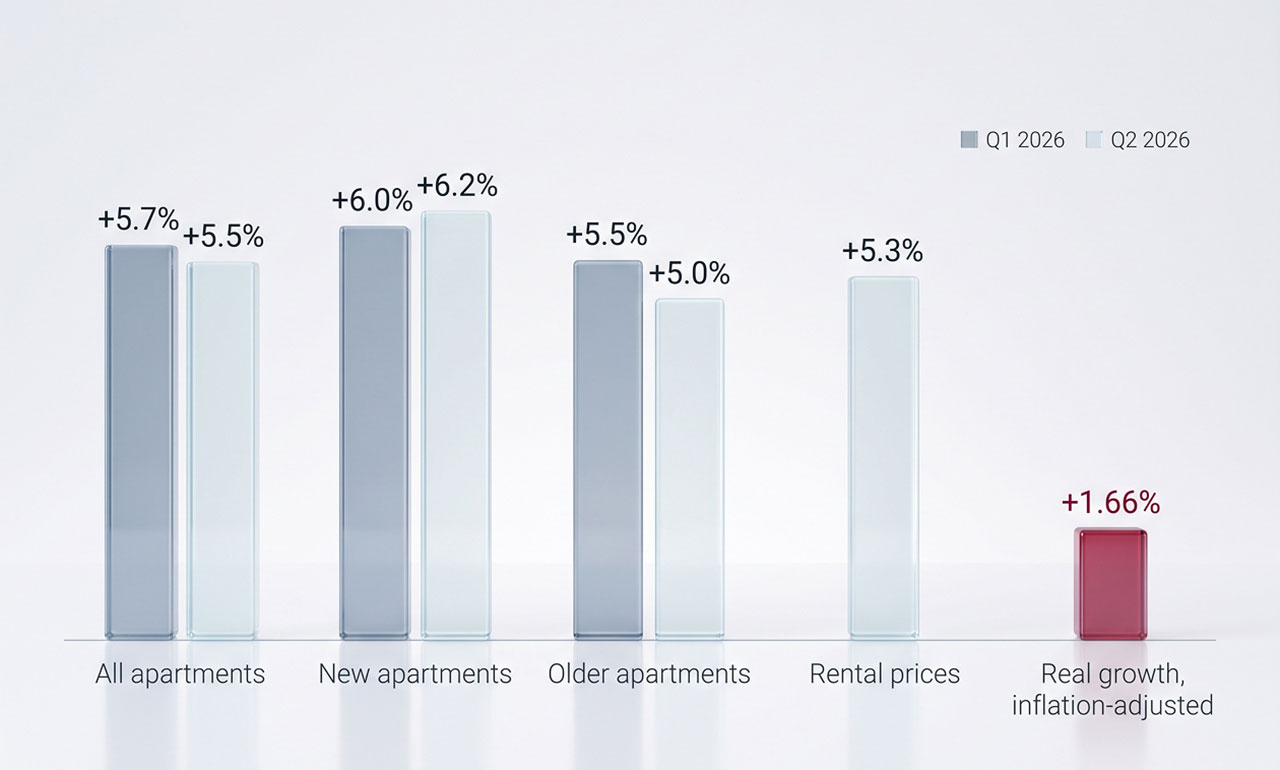
Once inflation is taken into account, however, the picture is more moderate. Real house-price growth in the first half of 2026 stood at around 1.66% year on year. Rental prices increased faster, by approximately 5.3%, reflecting the continuing shortage of good-quality long-term rental stock in the country’s main urban markets.
Housing affordability remains another important structural issue. From the post-crisis low, apartment prices have risen by around 85%, while disposable income per capita has increased by only 47%. This helps explain why domestic buyers remain more price-sensitive and continue to concentrate heavily in older secondary housing, while foreign capital plays a larger role in new developments, premium property and professionally redeveloped stock.

The market hasn't cooled. It has matured. Prices are still rising, but buyers are now much more selective, and the gap between quality stock and everything else keeps widening. A renovated, energy-efficient apartment in a good location sells quickly. An ordinary older unit has to be priced correctly to move. For investors, the average price per square metre matters much less than the specific building, street and specification.
Nasos Fousias
Head of Property Department in Greece
A national or city-wide average says relatively little about what an international investor actually pays for investment-grade property in Greece. Broad housing indices are heavily influenced by older apartments, whereas newly delivered or comprehensively renovated properties trade at a substantial premium.
In Central Athens, for example, the general benchmark is around €2,500 per sq. m, yet professionally renovated or converted stock is typically priced between €4,200 and €5,800 per sq. m. Prime property in Kolonaki can move above €7,000–9,500 per sq. m. The same pattern can be seen in Piraeus and is even more pronounced on the Athens Riviera.
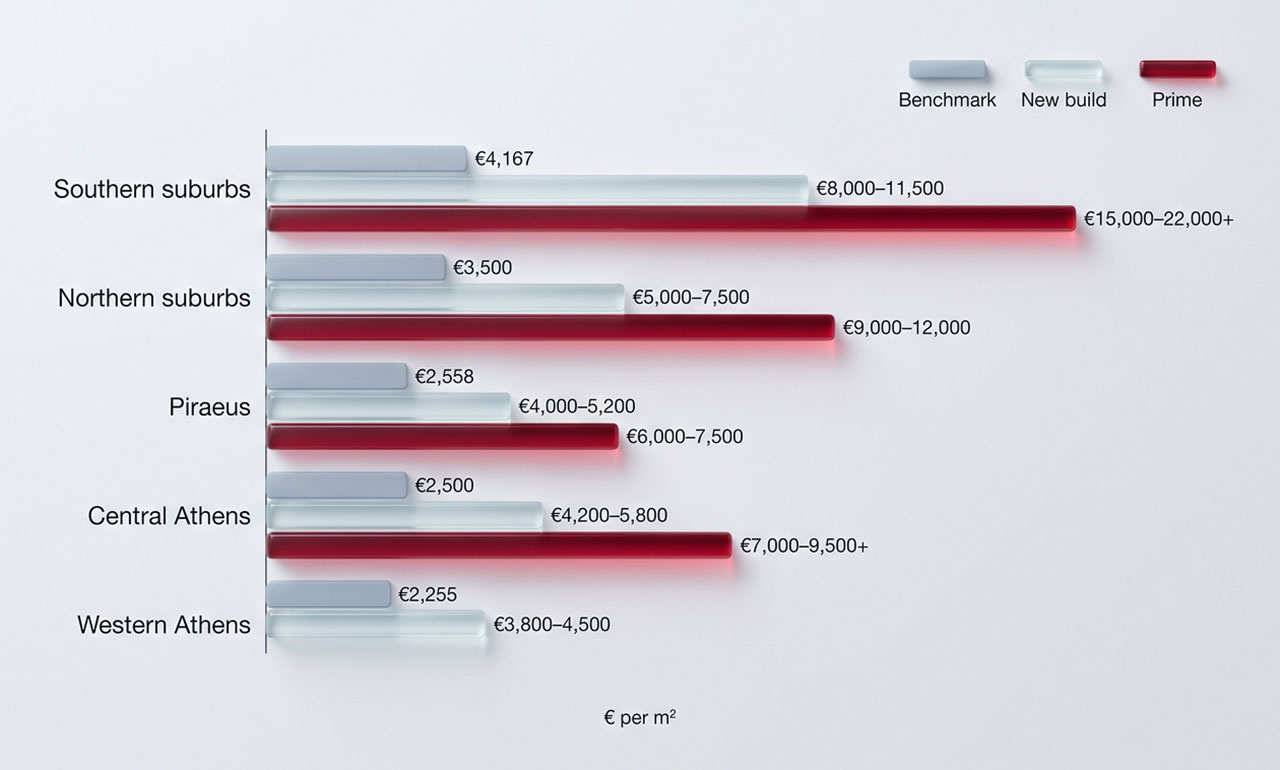
This difference is not simply a Golden Visa premium. In conversion projects, the purchase price incorporates the acquisition and redevelopment of an existing commercial building, legal change of use, structural and seismic works, energy upgrades, new engineering systems, interior fit-out and often full furnishing. Comparing this product directly with an unrenovated apartment in a 1970s building can therefore be misleading.
The 2024 reform created a more fragmented investment landscape. Standard residential property in Attica, Thessaloniki, Mykonos, Santorini and qualifying larger islands now requires at least €800,000 invested in a single property with a minimum main area of 120 sq. m. In the rest of the country, the standard residential threshold is €400,000, again with the 120 sq. m requirement.
A separate €250,000 route remains available nationwide for qualifying commercial-to-residential conversions and listed buildings acquired for restoration. These categories are not subject to the 120 sq. m minimum, which has made them particularly important in markets where the standard threshold is otherwise €800,000.
| Golden Visa property route | Minimum investment | Minimum area | Main application |
|---|---|---|---|
| Standard residential, Zone A | €800,000 | 120 sq. m | Attica, Thessaloniki, Mykonos, Santorini and larger islands |
| Standard residential, Zone B | €400,000 | 120 sq. m | Other qualifying regions |
| Commercial-to-residential conversion | €250,000 | No statutory minimum | Nationwide |
| Listed-building restoration | €250,000 | No statutory minimum | Nationwide |
In Athens, the €250,000 conversion route is attractive because it offers newly redeveloped, fully finished properties at a much lower entry cost. These apartments are often located in well-connected or prestigious areas and can offer stronger rental returns than standard residential properties priced from €800,000.
On the Athens Riviera, even €800,000 is often insufficient for qualifying new-build stock. Once the minimum 120 sq. m size is combined with local prices, realistic entry budgets frequently exceed €1M.
Based on monthly data from the Greek Ministry of Migration and Asylum, Golden Visa demand remained active in the first half of 2026, although application volumes were lower than during the unusually strong transition period of 2025. Between January and June, 2,589 initial applications were submitted, compared with 4,500 a year earlier. The difference was most pronounced at the beginning of the year, but narrowed significantly by late spring: applications were only 2.4% lower year on year in May and 11.0% lower in June.
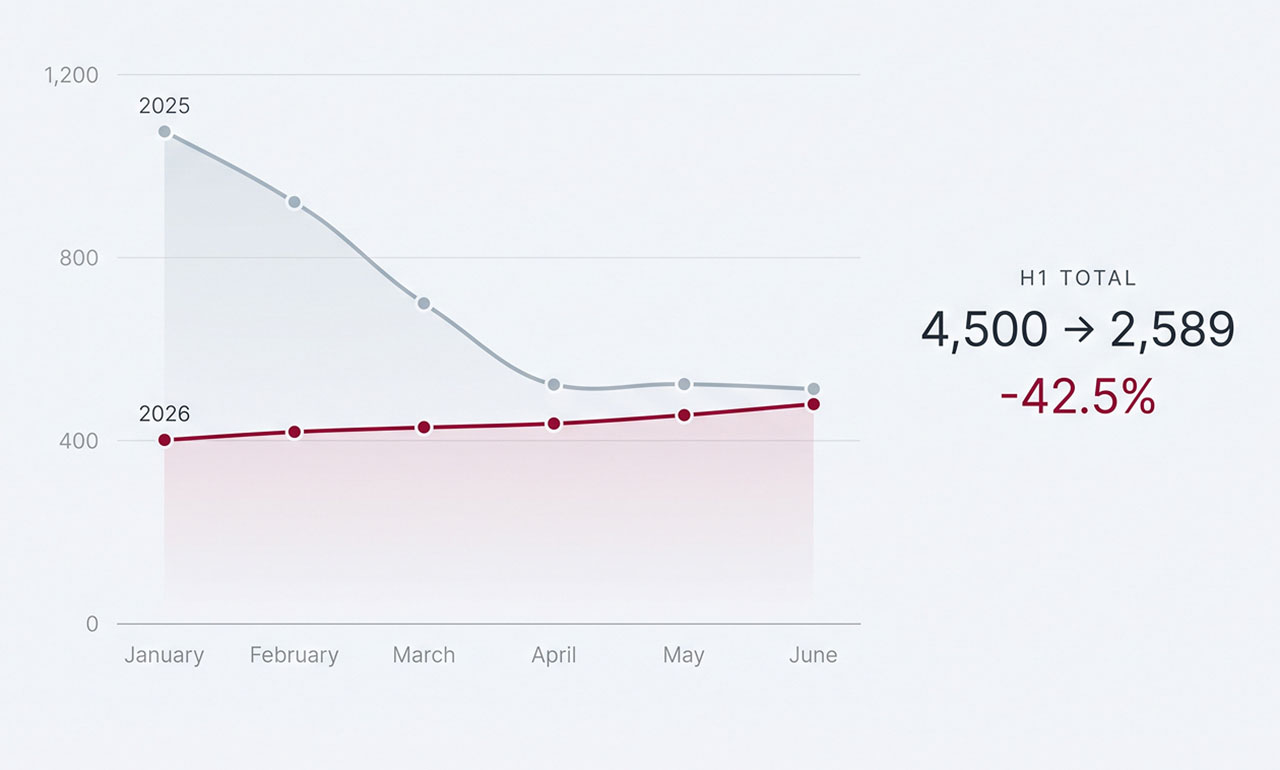
The comparison reflects a high base in 2025, when many investors accelerated purchases ahead of the expiry of transitional rules and the full implementation of the new €250,000, €400,000 and €800,000 thresholds. By 2026, the market had moved into a more stable phase, with demand adjusting to the new structure rather than disappearing.
Permit issuance also accelerated. A total of 5,544 initial Golden Visas were issued in H1 2026, up from 4,310 in the same period of 2025, showing that migration authorities were processing accumulated applications more quickly. The share of H1 applications already approved also increased to 33.1%, compared with 16.8% for the equivalent 2025 cohort.
Overall, the data point to a normalisation of Golden Visa activity after the transition-driven surge, while continued monthly application volumes and faster approvals show that investor interest in the program remains significant.
Official Ministry of Migration data also show a decline in the stock of unresolved Golden Visa cases. At the end of January 2026, 11,147 Golden Visa applications filed since 2022 — including initial applications and renewals — were still pending. This fell to 10,796 in February and 10,032 by March. Over the same period, the number of issued decisions increased from 26,629 to 28,768.
By March, 73% of the 39,179 Greece Golden Visa applications filed since 2022 had resulted in permits being issued, while 26% remained pending and around 1% had been rejected. The figures reinforce the distinction between current investment demand and permit issuance: 2026 is seeing fewer new applications, but considerably more administrative capacity is being used to clear applications generated during the earlier investment surge.
For the property market, this means the 42.5% fall in H1 applications should not be interpreted as a 42.5% contraction in Golden Visa-related transactions. Part of the comparison reflects the exceptionally high base created by the transition to the new thresholds, while the much smaller year-on-year gaps recorded in May and June suggest that demand had already begun to settle at a more normalized level by the end of the half-year.
Golden Visa demand remains highly concentrated by nationality. As of March 2026, Chinese nationals held 11,136 valid initial investor permits, representing 48.4% of the total. Turkish investors were the clear second-largest group with 3,820 permits, or 16.6%, meaning that China and Turkey together accounted for almost two-thirds of valid initial investor permits.
Lebanese investors accounted for a further 4.6%, followed by Iran at 3.9%, the UK at 3.6%, Israel at 3.1%, and the US and Egypt at 2.6% each. The distribution shows that the program is gradually becoming more geographically diverse, but it remains far more concentrated than Greece’s broader foreign property market.
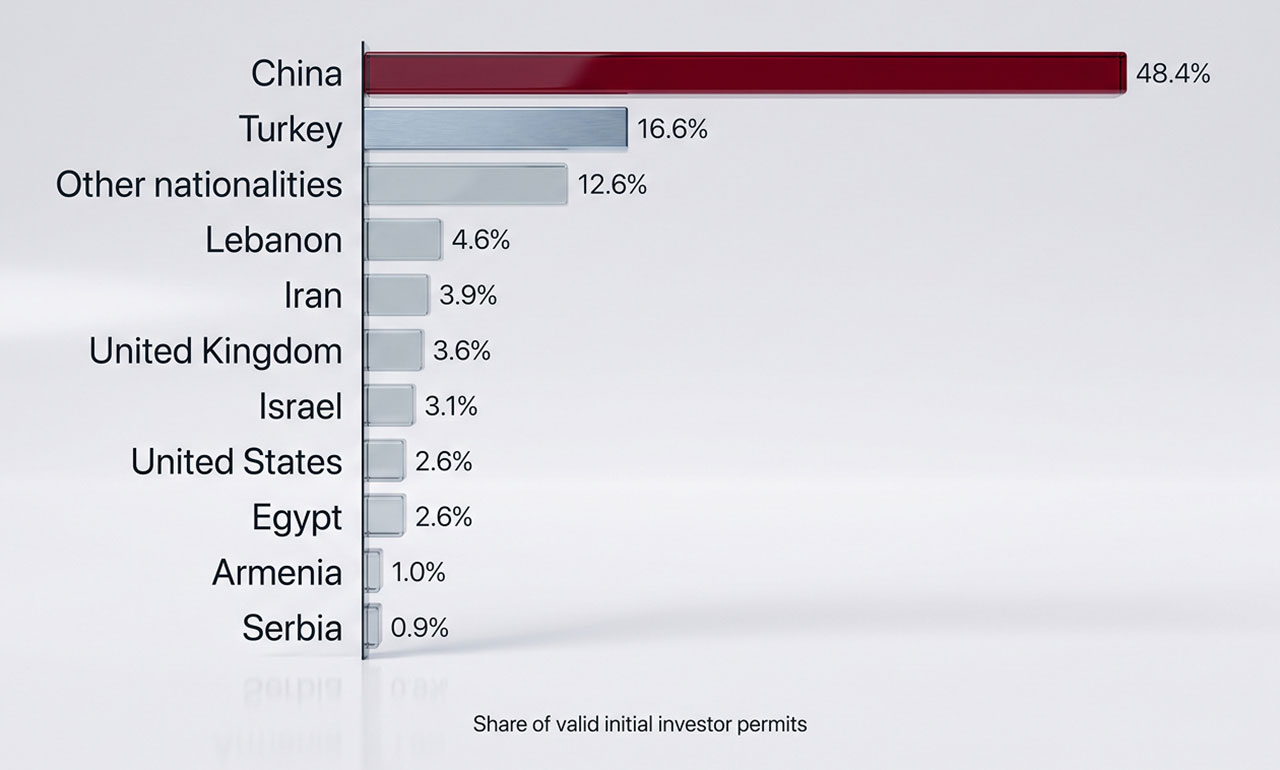
Turkey is one of the clearest sources of growing Golden Visa demand. Its share increased from 16.3% in February to 16.6% in March 2026, while China remained broadly stable at around 48%. The scale of the Chinese investor base therefore remains much larger, but the Turkish market is becoming increasingly important in the program’s current demand mix.
Chinese investors remain the largest nationality group within Greece’s Golden Visa system, representing more than half of all active investor permits as of mid-2026. This gives Chinese buyers by far the strongest presence within the residency by investment market.
The investor base is nevertheless becoming broader. US buyers are taking a growing share of higher-value transactions, while investors from the UK, Israel and Turkey are also among the significant foreign buyer groups. Their property preferences are not necessarily the same: buyers focused primarily on Golden Visa efficiency tend to be more active in the €250,000 urban conversion segment, while higher-net-worth investors are more visible in premium new developments and coastal property.
| Buyer group | Position in the market | Typical demand profile |
|---|---|---|
| China | More than 50% of active investor permits | Strong Golden Visa-driven demand, particularly for urban investment property |
| United States | Growing share | Higher-value residential, prime and lifestyle property |
| United Kingdom | Significant foreign buyer group | Residential and lifestyle demand |
| Israel | Significant foreign buyer group | Athens and premium markets |
| Turkey | Significant foreign buyer group | Urban residential and Golden Visa-related demand |
The distinction between residence permits and actual property transactions is important here. Golden Visa statistics show who holds investor residence permits, not the full nationality distribution of all foreign property buyers in Greece. Foreign nationals can buy property without applying for residence, while the permit itself may be issued months after the purchase.
The dominant investment product in 2026 is the commercial-to-residential conversion. More than 75% of new applications are associated with the €250,000 conversion route, while approximately 15–18% relate to premium property at €800,000 or above. Less than 7% is distributed between the €400,000 regional category and financial investment options.
This has had a direct impact on both development activity and the type of property reaching the market. A typical €250,000 Golden Visa unit is now a studio or one-bedroom apartment of approximately 40–65 sq. m, often delivered fully renovated and furnished. Prices in professionally managed projects usually range from €4,000 to €5,800 per sq. m.
The premium segment looks entirely different. Buyers investing €800,000 or more typically target large apartments, new-build residences, penthouses or coastal property. Here, the investment case is less about maximizing rental yield and more about combining residence rights with lifestyle, capital preservation and long-term exposure to scarce high-end stock.
| Segment | Typical property | Typical size | Typical investment |
|---|---|---|---|
| Urban conversion | Studio or 1-bedroom apartment | 40–65 m² | €250,000–280,000 |
| Premium central conversion | High-quality refurbished apartment | 45–65 m² | €280,000–350,000 |
| Standard Zone A residential | Large apartment / new build | 120 m²+ | €800,000+ |
| Athens Riviera | Prime residence | 120 m²+ | €1M–2.5M+ |
| Thessaloniki conversion | Student or serviced apartment | 50–65 m² | Around €250,000 |
| Crete premium market | Villa or coastal residence | Varies | High-value segment |
We see two very different buyers. The first is focused on residency and wants a well-executed €250,000 conversion in a central, well-connected area with reliable rental demand. The second is buying lifestyle and long-term value on the Athens Riviera. That second segment is often underestimated. In Glyfada, quality new builds now regularly trade above €10,000 per square metre, and in Vouliagmeni the best new projects can approach €20,000. A qualifying €800,000 purchase there is, in practice, a €1 million-plus decision.
Nasos Fousias
Head of Property Department in Greece
Several forces are reshaping Greece’s property market in 2026, from limited modern housing supply to infrastructure investment and changes in Golden Visa demand.
Athens remains the largest and most diverse real estate market in the country. Central districts, western suburbs, Piraeus, the northern residential belt and the Athens Riviera differ substantially in pricing, property type and tenant profile.
The variation is large enough that metropolitan averages have limited value for serious investment analysis. An investor buying a converted apartment in Kypseli is operating in a completely different market from someone acquiring a 150 sq. m new-build residence in Glyfada.
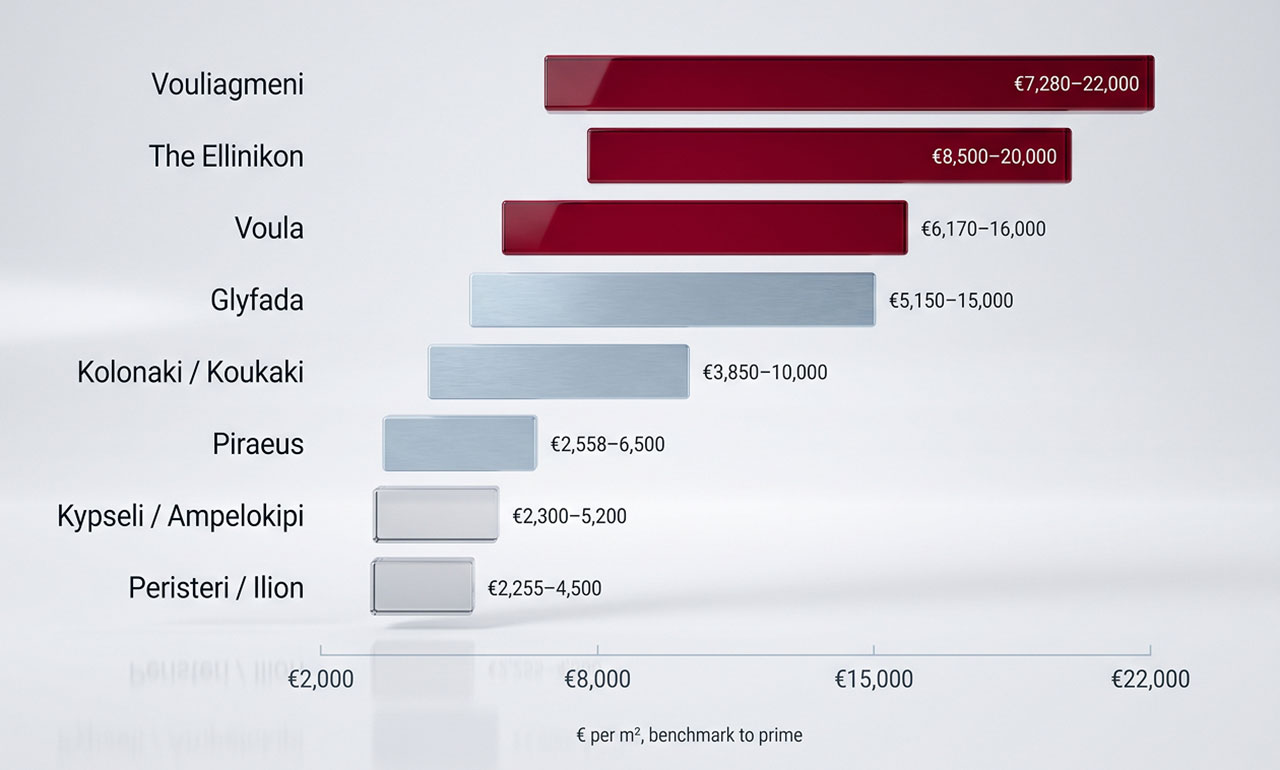
Central Athens has very limited room for large-scale greenfield development, which makes redevelopment increasingly important. In areas such as Kypseli, Ampelokipi and Exarchia, developers are converting older office and commercial buildings into modern residential projects, often with upgraded energy performance and full interior renovation.
This helps explain the large gap between the general market and investment-grade stock. A typical secondary apartment may be priced near €2,300–2,500 per sq. m, while a fully redeveloped product can command €4,200–5,200. In Kolonaki, the premium rises much further, with high-quality stock reaching €6,500–9,000 per sq. m.
For Golden Visa buyers using the €250,000 conversion route, typical units in central districts are around 48–60 sq. m and priced at approximately €250,000–270,000. In more premium central locations, the ticket can move towards €280,000–350,000.
Piraeus has become one of the main institutional redevelopment hubs in Attica. The area combines a large stock of former industrial and commercial property with strong transport links, port activity and growing business infrastructure.
The broad secondary-market benchmark remains around €2,558 per sq. m, but high-quality conversion projects are priced at roughly €4,000–5,200. Premium penthouses and marina-facing properties can exceed €6,500 per sq. m.
The typical Golden Visa product costs around €250,000–280,000 and offers approximately 45–65 sq. m of internal space. Piraeus is therefore one of the clearest examples of how the €250,000 threshold has stimulated a specific redevelopment market rather than simply supporting ordinary secondary-property purchases.
Western districts such as Peristeri and Ilion remain significantly cheaper than the centre or the southern suburbs, but they have recorded strong price growth. The wider western-Athens benchmark reached approximately €2,255 per sq. m after a 9.7% annual increase.
Redeveloped properties typically trade at €3,800–4,500 per sq. m, with investment units of around 55–65 sq. m priced at €250,000–265,000. Rental demand is more closely tied to local Greek households than to tourism, which gives this part of the market a different risk profile from central or coastal locations.
The Athens Riviera is effectively a separate premium market. In Glyfada, quality new developments are generally priced at €8,000–9,500 per sq. m, while prime residences can reach €12,000–15,000. Voula trades higher, with premium developments at €13,000–16,000 per sq. m.
Vouliagmeni sits at the top of the market. Modern projects commonly start around €12,500–15,000 per sq. m, while waterfront properties can exceed €18,000–22,000. The Ellinikon adds another layer, with Little Athens at approximately €8,500–11,500 and Marina Tower or waterfront residences at around €18,000–20,000 per sq. m or more.
Because standard Golden Visa property in Attica must be at least 120 sq. m, the legal €800,000 threshold significantly understates the real capital requirement in these locations. A qualifying property in Glyfada may realistically require €1.0–1.3M, while The Ellinikon typically starts closer to €1.2M and Vouliagmeni around €1.8M.
We see two very different buyers. The first is focused on residency and wants a well-executed €250,000 conversion in a central, well-connected area with reliable rental demand. The second is buying lifestyle and long-term value on the Athens Riviera. That second segment is often underestimated. In Glyfada, quality new builds now regularly trade above €10,000 per square metre, and in Vouliagmeni the best new projects can approach €20,000. A qualifying €800,000 purchase there is, in practice, a €1M-plus decision.
Thessaloniki remains the second major urban property market in Greece. Prices rose by 6.4% year on year in Q1 2026 and by 4.7% in Q2, while the broader secondary-market benchmark stands at approximately €2,667 per sq. m.
Premium new-build stock in central areas and Kalamaria can reach €5,500–6,500 per sq. m. At the same time, the €800,000 Golden Visa threshold for standard residential property has pushed developers towards the conversion segment, particularly around areas benefiting from the new metro.
The city’s large student population creates a natural market for compact furnished apartments. Conversion projects typically offer units of around 50–65 sq. m at €3,800–4,800 per sq. m, with total investment starting at approximately €250,000 and expected gross rental yields of around 5–6%.
Crete has a different supply profile. Chania is heavily influenced by lifestyle and international coastal demand, with premium villas and seaside property typically priced at €4,500–7,000 per sq. m or higher.
Heraklion is more urban and year-round in character. New residential stock is generally priced around €3,200–4,200 per sq. m, supported by demand from the university, healthcare sector and local professional population.
Commercial conversion opportunities are more limited than in Athens or Thessaloniki because Crete has a smaller stock of vacant office and industrial buildings. As a result, the €250,000 restoration route can be more relevant, particularly in historic centres such as Chania and Rethymno.
Residential prices are expected to continue rising, but at a slower pace than during the strongest post-pandemic years. The national market is moving towards more moderate growth, while performance is becoming increasingly dependent on property quality, location and supply constraints.
Modern new-build housing, professionally redeveloped conversion projects and prime coastal property are likely to remain more resilient than older secondary stock. In Athens in particular, the shortage of modern housing and limited development land should continue to support a premium for high-quality assets.
The €250,000 conversion segment is likely to remain one of the most active parts of the Golden Visa market, but suitable commercial buildings are becoming harder to source in central Athens and Piraeus. As the most obvious redevelopment opportunities are absorbed, developers are increasingly looking towards secondary districts and the wider Attica area.
This shift may gradually change the geography of new conversion projects and increase competition for buildings that already meet the legal, planning and technical requirements for redevelopment.
Glyfada, Voula, Vouliagmeni and The Ellinikon are expected to remain structurally different from the wider Athens residential market. Limited prime supply, large-scale development and international demand continue to support prices well above the metropolitan average.
The Ellinikon in particular is establishing new benchmarks for high-end residential development and reinforcing the Athens Riviera as one of Greece’s main international luxury property markets. In this segment, pricing is driven less by mainstream domestic affordability and more by scarcity, location, specification and international demand.
The Ellinikon is a 6.2 million sq. m mixed-use redevelopment on the site of Athens’ former international airport and the neighbouring coastal area. It includes new residential districts, Marina Tower, hotels, offices, retail and leisure facilities, a marina and a large metropolitan park, and is one of the largest urban regeneration projects in Europe.
Greece plans to raise the property transfer tax on residential purchases by non-EU buyers from 3% to 15%. The current proposal points to July 1, 2027 as the start date.
The change has not yet taken effect, and the final rules may still include exemptions and transitional provisions.If implemented in its current form, the change would materially increase acquisition costs for non-EU buyers and could become an important factor in purchase timing during 2027.
Another issue to watch is the widening gap between market prices and Greece’s official zone values, which are used for taxation. In several parts of Athens, including Kolonaki, Kypseli, Exarchia, the southern suburbs, the Ellinikon area and Piraeus, recorded transaction prices are already significantly above official taxable values.
In Glyfada, a 65 sq. m apartment sold in June for €4,846 per sq. m, more than double the official zone value of €2,350 per sq. m. The gap reached 44% in Kolonaki and 35% in Kallithea, showing how far taxable values can lag behind real market pricing in some areas.
A new review of zone values is expected in the second half of 2027. The revised figures have not yet been determined, but a substantial increase in locations where official values remain well below market prices could raise property-related taxes and transaction costs for future buyers and owners.
My advice is to start with the strategy, not the listing. Decide whether your priority is residency, rental income or long-term capital preservation, because each one points to a different area and property type. Check the developer's track record and the legal status of the conversion carefully. Also keep an eye on the timeline: the proposed tax changes for non-EU buyers and the expected revision of zone values could make 2026 and early 2027 a more favourable window to buy than later on.
Nasos Fousias
Head of Property Department in Greece
Greece’s property market in 2026 is still growing, but investment opportunities are becoming more segmented. Compact conversion projects remain one of the most accessible routes for Golden Visa buyers, while premium markets such as the Athens Riviera continue to attract higher-budget investors focused on quality, location and long-term value. At the same time, limited modern housing supply, redevelopment activity, infrastructure projects and upcoming tax changes are likely to shape the market into 2027.
For investors, this makes property selection increasingly dependent on strategy rather than price alone. Astons helps buyers compare locations and property types, assess Golden Visa eligibility and investment potential, and manage the legal, technical and transaction process from selection to completion. Speak to our expert to build a property investment strategy tailored to your budget, goals and preferred location in Greece.

 Learn more
Request a Free Consultation
Book a free consultation today and let our specialists help you choose the best country for your family
Send a RequestAuthor

Nasos Fousias
Head of Property Department in Greece
Nasos Fousias brings over 15 years of senior leadership experience in Greek residential real estate development.
Learn more about the authorShare


Related Articles
schedule a Meeting
Let’s Discuss the Details
Our expert will create a tailored solution based on your needs within 24 hours.

Susanna Uzakova
Senior Citizenship & Residency Advisor
 Your Data is Protected
Your information is handled under strict privacy policies.