





































 +44 207 043 6026
  +357 252 30233
  +971 454 01311
  +902 129 008 710
  +302 112 340 656
  +1 (888) 2033901


Moving to Greece from USA
-
 17-MINUTE READ
 -
812 views
-
Share
 17-MINUTE READ
 812 views
 Share
Share
Susanna Uzakova
Senior Citizenship & Residency Advisor
- Last edited: March 6, 2026
Moving to Greece from the USA is a major life decision that combines legal planning, financial preparation, and practical relocation logistics. Whether you’re drawn by Greece’s Mediterranean lifestyle, affordable cost of living, or long-term residency opportunities, U.S. citizens must navigate specific visa rules, tax obligations, and administrative steps to make the transition successful. Americans typically relocate through three primary pathways:
Beyond securing the right visa, the move requires careful coordination: from obtaining a Greek tax number (AFM) and understanding U.S.-Greece tax treaties to budgeting for international shipping, housing, healthcare, and banking.
This guide walks you through every stage of moving to Greece from the USA, providing clear, practical insights to help you relocate with confidence.

To legally reside in Greece for more than 90 days, U.S. citizens must obtain a National (Type D) Visa before leaving the United States. This application is submitted to the Greek Consulate with jurisdiction over the applicant’s U.S. residence and must be approved prior to travel. After entering Greece on a Type D visa, the applicant then applies for a Residence Permit, which formalises long-term legal stay.
Each visa category is designed for a specific purpose such as investment, employment, retirement, study, or remote work, and selecting the correct pathway at the outset is critical, as switching visa types later can be time-consuming and restrictive.
Currency note: All USD figures below are approximate conversions from euros at €1≈ $1.17, based on December 2025 exchange rates.
U.S. passport holders may enter Greece and the wider Schengen Area visa-free for up to 90 days within any 180-day period. This short-stay privilege is intended strictly for tourism, family visits, or limited business meetings.
It does not permit employment, long-term residence, or study. Overstaying can lead to fines, entry bans, and complications with future visa applications. Anyone planning a permanent or semi-permanent move must secure a long-term visa before travelling to Greece.
For Americans intending to live in Greece, a Type D visa is mandatory. The visa category depends on the applicant’s income source, investment capacity, and lifestyle goals. Below are the principal long-term residency pathways available to U.S. citizens.
A residence permit may be issued to U.S. nationals who secure employment with a Greek company. Several employment-based routes exist:
The Greek employer must obtain prior approval from local authorities and issue a formal employment contract of at least one year. The residence permit is typically valid for the duration of the contract and is renewable.
Available to highly skilled professionals with a recognised university degree or at least three years of relevant experience. The job offer must meet a minimum salary threshold of approximately 1.5x the national average annual income. Permits are issued for 1-4 years.

U.S. citizens accepted into a recognised Greek educational institution may apply for a student residence permit.
Residence permits are issued for one year and renewed annually for the duration of studies.
Family members of Greek citizens or legal residents may apply for residence permits under family reunification rules.
For family members of Greek citizens, permits are issued for five years and are renewable, provided absences from Greece do not exceed two years within each five-year period.
The FIP visa is popular among retirees and individuals with passive income.
Residence permits are issued for three years, renewable for another three years. Employment in Greece is not permitted under this status.
Designed for remote workers employed by non-Greek companies.
The residence permit is issued for one year, with the option to extend for up to two additional years.
Entrepreneurs may obtain residency by establishing a business in Greece.

The Greece Golden Visa is one of Europe’s most attractive residency-by-investment programs, offering a five-year renewable residence permit with no minimum stay requirement.
Unlike other Greek residence permit types, the Golden Visa does not require the holder to live in Greece to maintain or renew the permit.
Investment thresholds depend on location and property type:
Non-real-estate options include investments in Greek companies, bonds, or regulated funds starting from €350,000 ($411,000).
Key benefits of the Greek Golden visa:
Moving to Greece from the USA follows a structured legal process that begins before departure and continues after arrival. U.S. citizens must first obtain a National (Type D) Visa from a Greek Consulate in the United States.
Preparation (1–3 months)
Applicants must gather all required documents in advance. U.S.-issued documents must be apostilled and officially translated into Greek. Common documents include criminal background checks, birth or marriage certificates (if applicable), proof of income or investment, health insurance, and accommodation evidence.
Consulate Application (4–12 weeks)
The Type D visa application is submitted in person at the Greek Consulate with jurisdiction over the applicant’s U.S. residence (e.g., New York, Los Angeles, Chicago). Processing times vary by visa category and consulate workload, but approval typically takes between 4 and 12 weeks.
Entry into Greece and Residence Permit Issuance (3–6 months)
After arrival in Greece, applicants must immediately apply for their physical residence permit at the local Decentralised Administration office. This includes biometric data submission and final document verification. While the permit is being processed, applicants receive a confirmation certificate allowing them to remain legally in Greece.
In total, from initial preparation in the United States to receipt of the residence permit card, the process usually takes 3 to 9 months, depending on visa type and document readiness.
The United States allows dual citizenship, so acquiring Greek citizenship through naturalisation (typically after 7 years of legal residence) will not jeopardise your U.S. nationality.
However, all U.S. citizens must continue to file a U.S. federal tax return annually, regardless of where they live. This obligation remains even if you become a Greek citizen or tax resident, due to the U.S.’s citizenship-based taxation system.

Navigating the dual tax systems of the U.S. and Greece is one of the most complex aspects of moving abroad.
You are considered a Greek tax resident if you spend more than 183 days in Greece in any calendar year, or if your primary personal or economic interests are located in Greece.
Worldwide Income: As a Greek tax resident, you must report your worldwide income to the Greek tax authorities.
Double Taxation: The U.S.-Greece Double Taxation Treaty prevents taxation of the same income twice, but it does not remove your U.S. filing obligations.
U.S. Tax Obligations: The U.S. taxes its citizens on worldwide income, regardless of residence.
| Form / Document | U.S. Requirement | Greek Requirement |
|---|---|---|
| Form 2555 | Filed with the U.S. tax return to claim the Foreign Earned Income Exclusion (FEIE). | Not required |
| FinCEN Form 114 (FBAR) | Mandatory U.S. Treasury filing if total foreign account balances exceed $10,000 at any point during the year. | Not required |
| Greek AFM (Tax Number) | Not required | Mandatory for all financial activities in Greece, including banking, renting property, utilities, and tax filings |
The AFM (Greek tax number) is typically the first administrative step after arrival and can be obtained at the local tax office (Eforia) by presenting a valid passport.
The cost of moving to Greece is a major factor, with legal fees, airfare, and shipping being the largest upfront expenses.
The costs depend heavily on your chosen visa route:
| Visa Type | Primary Costs (Estimated) |
|---|---|
| Digital Nomad / Financially Independent Person (FIP) Visa |
|
| Golden Visa (Real Estate-Based) |
|
| Work / Student Visa |
|
| Family Reunification Visa |
|
| Self-Employment / Business Visa |
|
All USD figures above are approximate conversions from euros at €1≈ $1.17, based on December 2025 exchange rates.
Expect to pay about $400 on average for a one-way international flight from a major U.S. hub (e.g., New York, Chicago) to Athens (ATH) or Thessaloniki (SKG).
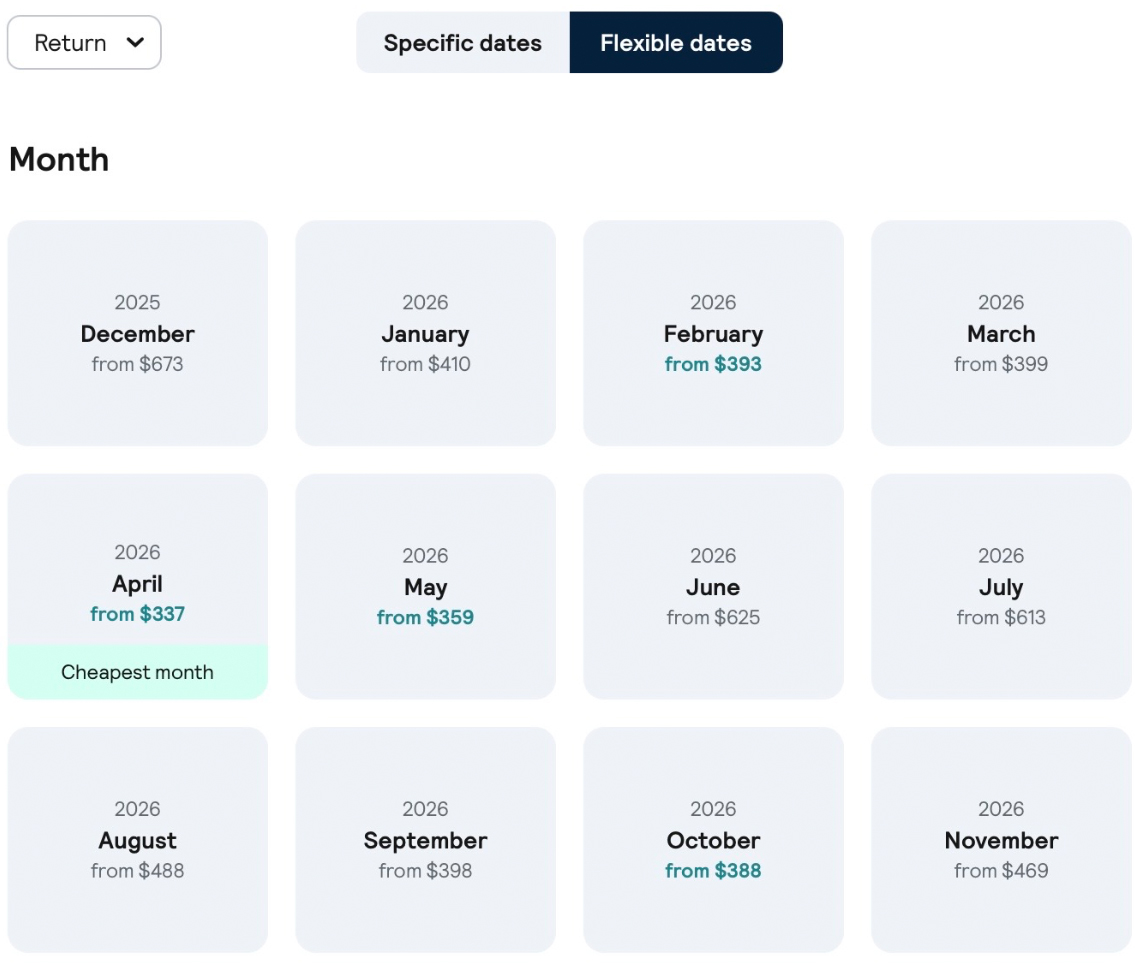
Source: Skyscanner, as of December 2025.
Shipping household goods can be expensive. Costs are volatile but estimated as:
Securing rental housing in Greece typically requires upfront payments:
Rental prices vary by city and property type, generally lower than U.S. cities (Numbeo 2025 data)
| City / Area | 1‑Bedroom (City Center) | 1‑Bedroom (Outside Center) | 3‑Bedroom (City Center) |
|---|---|---|---|
| Athens | ~$761–$1,053 / month | ~$527–$761 / month | ~$1,404–$2,106 / month |
| Thessaloniki | ~$585–$878 / month | ~$410–$604 / month | ~$1,053–$1,638 / month |
| Crete (Heraklion) | ~$585–$820 / month | ~$410–$604 / month | ~$1,053–$1,521 / month |
| Rhodes | ~$527–$761 / month | ~$351–$585 / month | ~$936–$1,404 / month |
| Santorini / Mykonos | ~$820–$1,404 / month | ~$585–$936 / month | ~$1,755–$2,925 / month |
All USD figures above are approximate conversions from euros at €1≈ $1.17, based on December 2025 exchange rates.
Comparison with U.S. Cities:
The official currency is the Euro (€). Always use a reliable exchange service or bank for currency transfers, avoiding airport kiosks for large sums. As of December 2025, $1 USD ≈ €0.85 (check current rates before moving).
Preliminary tax estimates are crucial; consult an expat tax specialist early.
Greece’s non-domiciled (non-dom) regime offers an attractive option for high-net-worth expats:
Choosing where to settle will define your lifestyle. American expats are spread across the country, but these cities offer the best blend of amenities, community, and opportunity.
As the capital, Athens is the primary destination for Americans seeking employment, business opportunities, or a cosmopolitan lifestyle.
Pros:
Cons:
Thessaloniki, Greece’s second-largest city, offers a vibrant, youthful feel, and a major port.
Pros:
Cons:
For a slower, more traditional Mediterranean pace, the major islands are ideal, especially for retirees and remote workers.
Crete:
Rhodes:

Relocating from the United States to Greece requires advance planning, especially when transporting household goods or pets. Understanding customs rules and logistics can help avoid delays and unexpected costs.
To avoid duties and taxes on personal household goods, you must prove that you have legally owned and used the items in the U.S. for at least six months prior to your move.
Transfer of Normal Residence:
You must apply for a Certificate of Transfer of Normal Residence to qualify for duty-free import of your household goods.
Inventory Requirements:
Prepare a highly detailed, itemised inventory of everything included in your shipment. This inventory must be translated into Greek and certified before submission to customs authorities.
Restricted Items:
Certain goods are subject to strict regulations or high import taxes, including:
Failure to declare restricted items correctly can result in significant delays, penalties, or confiscation.
Always request quotes from at least three international moving companies that specialise in U.S.–to–Greece relocations. Commonly referenced providers include Chipman International, Mountain Moving & Storage, and Kronos.
Door-to-Door Services:
Door-to-door shipping is strongly recommended. This option covers packing, ocean freight, customs clearance in Greece, and delivery to your final residence.
Insurance Coverage:
Comprehensive moving insurance is essential. Ensure your policy covers both ocean transit and inland transportation within Greece, protecting against loss or damage.
Greece follows standard EU regulations for importing pets (dogs, cats, and ferrets).
Microchip:
Pets must be fitted with a functioning microchip. If the chip is not ISO-compliant, you must either:
Rabies Vaccination:
The rabies vaccine must be administered after microchipping and at least 21 days before entry into Greece.
It is recommended to obtain a one-year rabies vaccination 21 days to 12 months before travel (ideally 3–6 months in advance) to avoid multiple certificate requirements.
Rabies Titer Test:
A rabies antibody titer test is mandatory. The test must be conducted by an accredited laboratory and submitted to EU authorities within the required timeframe. Always verify current requirements via State.gov or USCIS.gov.
EU Health Certificate:
An EU health certificate must be:
When all requirements are met correctly, pets are generally exempt from quarantine.
Opening a Greek bank account as an American involves several steps due to international compliance regulations such as FATCA.
Step 1: Obtain an AFM Number
Before a bank will open an account, you must secure a Greek Tax Number (AFM, Arithmo Forologiko Mitro). This is the most critical prerequisite.
Step 2: Prepare Documentation
You will need:
Step 3: In-Person Verification
Most major Greek banks such as Piraeus Bank and Eurobank require a branch visit for identity verification and FATCA compliance checks.
For American expats, Athens offers the most dynamic job market, with two primary paths: remote work or local employment.

Greece’s national system (ESY) serves legal residents contributing to the social security fund (EFKA).
Most American expats opt for private insurance, often mandatory for Type D visas (Digital Nomad or Golden Visa).
Getting Your Greek ID and Driver’s License
Step 1: Online Application
Apply via the official myAADElive portal (AADE – Natural Person VAT No) entering personal details and passport information.
Step 2: Schedule Videocall Appointment
Provide supporting documents (passport, residence permit, birth certificate if applicable).
Step 3: AFM Issuance
Once approved, you’ll receive your AFM and authentication password. Essential for banking, rental contracts, and utilities.
Pro Tip: Begin the process before arrival or immediately upon landing to save time.
Budgeting in Euros is straightforward, but expect cost-of-living differences:
| Category | Athens, Greece | Chicago, USA |
|---|---|---|
| Grocery (basic basket for 1 month) | $292–$410 | $500–$650 |
| Local produce (fruits & vegetables) | $1.17–$3.50/kg | $3–$5/lb |
| Dining out (mid-range restaurant, 2 people) | $35–$59 | $70–$100 |
| Coffee (cappuccino, café) | $2.35–$3.50 | $4–$5 |
Tipping: Routing up or leaving 5-10% is customary.
Athens, Thessaloniki, and Crete host vibrant expat communities.
Relocate between October and April to sidestep inflated summer prices for flights and accommodation. Tourist season also shows down administrative processes.
Expect delays, especially in summer. Start visa an AFM applications early and keep digital copies of all documents to avoid setbacks.
Save the U.S. Embassy in Athens emergency contact before travelling. It’s essential for passport renewal, voter registration, and urgent assistance.
Reduce your environmental footprint by using reusable packing materials and exploring carbon offset programs for flights and freight.

Relocating to Greece is transformative, but navigating property and residency regulations can be complex.
Astons simplifies the process through the Greek Golden Visa program.
Discover how we helped an Oregon investor secure a Greek Golden Visa with a €400,000 penthouse in Piraeus here.
Our Expertise Includes:

 Learn more
Request a Free Consultation
Book a free consultation today and let our specialists help you choose the best country for your family
Send a RequestAuthor

Susanna Uzakova
Senior Citizenship & Residency Advisor
Suzanna Uzakova is an international specialist and a leading expert at the company in the field of investment immigration.
Learn more about the authorShare


Related Articles
schedule a Meeting
Let’s Discuss the Details
Our expert will create a tailored solution based on your needs within 24 hours.

Susanna Uzakova
Senior Citizenship & Residency Advisor
 Your Data is Protected
Your information is handled under strict privacy policies.